Creating great content is only half the battle. To truly engage your audience, the message you send has to inspire people or solve their problems. But from a business standpoint, the real magic happens when readers take action—like filling out a lead form and eventually making a purchase. Understanding what drives these decisions and finding ways to influence them is what Conversion Rate Optimization (CRO) is all about.
Conversions aren't set in stone, though: they change with seasons, trends, and customer preferences. CRO is an ongoing process of making small but impactful adjustments to your digital marketing strategy. The data, features, and insights that come with dedicated conversion rate optimization tools can be a game changer. So let's explore which solution is the right fit for you!
In this guide, you'll discover versatile tools, actionable tips, and real-life examples that will help you convert leads more effectively. And for a quick tool overview, scroll down to the very end of this post to find our handy CRO software comparison chart.
What Is Conversion Rate Optimization (CRO)?
In marketing, Conversion Rate (CR) is the percentage of users, website visitors, or leads who complete a specific desired action. Booking a free trial, downloading a PDF, upgrading to a paid plan, or making a repeat purchase are just a few examples. To assess the CR for a certain campaign, you need to take the number of conversions, divide it by the total size of your audience, and multiply by 100%.
💡 Let's say you calculate the CR for your recent project and find it to be 5%. But is that a good conversion rate, or does it leave room for improvement? Without context, a single number won't tell you much. You need to track CRs systematically and compare them against industry averages—or your own metrics in the past.
Conversion Rate Optimization encompasses all the different tools and techniques that help you enhance campaign efficiency. Depending on your needs, the list may include event-based analytics, A/B testing, session recordings, customer journey maps, interactive content formats, or landing page and survey builders. With these various strategies, you can boost your conversion rates. The main benefits of CRO are:
📈 Maximizing existing traffic. Get the most out of the leads you already have without spending money and resources on finding new ones.
🔍 Understanding your audience. Gain insights into which topics resonate most, refine your messaging, and test new creative content ideas.
🛠️ Improving user experience. Leverage data or feedback to identify pain points in your customers' journeys and see opportunities for growth.
🚀 Elevating your brand. Enhance content presentation to make it more engaging and impactful, which will work wonders for your brand positioning.
Why Your Potential Customers Fail to Convert
While сonversion rate optimization tools can give you a wealth of data, you'll still need to figure out what those numbers really mean. For instance, you might notice that many visitors drop off at a certain stage of their digital journey, or that some CTA buttons aren't performing well. To truly improve your conversions, dig deeper—into customer behavior, perspective, and feedback. And here are some common reasons why leads may not complete the desired actions:
🌀 Complex navigation: An average e-commerce site can gain a 35.3% increase in CR through better checkout design—so clear logic and flow are crucial.
⏳ Slow loading speed: Nothing frustrates people more than the delay in page load time. Every 1-second delay can reduce conversions by 7%, and after the first two seconds, users already lose focus.
📝 Lengthy forms: Forms can do wonders for better engagement, but not when they start to drag out. Going from 4 to 3 fields can increase your CR by up to 50%.
🔒 Lack of trust: If your branding isn't clear or links look suspicious, potential customers might hesitate to engage further. Also, branded traffic bounces 17 points lower than informational queries.
🥱 Unengaging content: 85% of marketing teams say user expectations are increasing, and content that fails to engage your audience and resonate with their needs will bring conversion rates down.
🎭 While low conversion rates may feel like a crisis, you shouldn't get discouraged. In fact, the insights you get from lost leads can be just as valuable—if not more so—than praise from your satisfied customers. With conversion rate optimization, you can turn the tables and make your content perform even better.
Conversion Rate Optimization Trends and Best Practices
Optimizing conversion rates is quite technical: you need to keep up with all the trends and latest customer behavior research, constantly update your website and content, and monitor key performance metrics. And yet, there is a more emotional side to the process as well, which requires connecting with your leads on a deeper level. Understanding their needs, feelings, and motivations can help you create a more engaging experience and raise CRs even higher.
📱 Mobile traffic is on the rise, and so are page speed expectations
The shift of web traffic from desktop to mobile is not a new trend, but it's reaching record highs in 2026. In some markets and industries, mobile dominates at 80%+, with an average of 64% across the globe. Even Google's default standard is mobile indexing, meaning responsive content directly dictates your rankings and visibility. And yet, despite the higher traffic share, most digital brands face a mobile conversion gap: approximately 8% lower CR than desktops.
Smaller screens immediately change user perspective. A big part of that is page load speed. Scrolling through plain text quickly gets boring, and a heavy image that appears bit by bit frustrates visitors. The same goes for any content type. Take flipbooks, for example—interactive digital publications made from PDFs. Here at FlippingBook, we did our own research on how improved flipbook loading speed influences its performance. We saw that bounce rates dropped 6%, while audience engagement rose by 9%. The perfect combo for more conversions!
Why Flipbook Loading Speed Matters
Have a PDF document? Turn it into a flipbook
⭐ Actionable tips:
- Make your fonts bigger. The easier they are to read, the better. You can also switch from JPEG to AVIF images to consume less mobile traffic.
- 75% of mobile interactions are made with the thumb, so try placing a CTA or a form right there. Hard-to-reach top corners shouldn't have any key buttons.
- Take advantage of tools that automatically make your content responsive: website builders, flipbook makers like FlippingBook, video players, etc.
💬 Surveys and forms need to be shorter than ever
Surveys are a powerful element of conversion rate optimization strategies. They let you collect contact information, find out more about customer preferences, and test assumptions. Recent studies show that moving from a 15-minute survey to a 5-minute one can raise response rates by 10–25%. So review all your forms to keep them short and sweet, or switch to smart question types like scale, multiple choice, or ranking.
Conversational surveys are definitely on the rise—in a more engaging AI-powered chat or video interview format—but you have to apply this trend carefully not to overcomplicate the process for your website visitors.
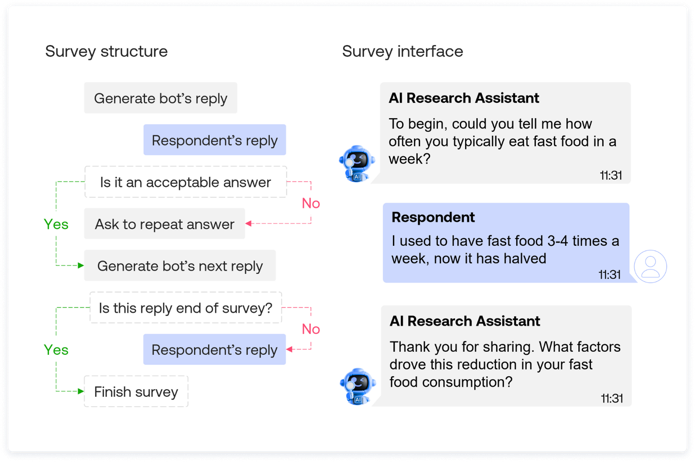
Conversational survey example explained. Image source: Conjointly
⭐ Actionable tips:
- To make surveys feel more personal, try conditional branching: set up different outcomes based on the form taker's answers to previous questions.
- With open-ended questions, you can analyze the language your audience uses to describe their needs and pain points, and mirror it in your copy.
- A/B test whether leaving forms optional or not letting people skip them is better for your CRs. Most survey tools have that option built in.
🚀 Static content is last season—the future is interactive
Unlike static texts and images, interactive elements create an immersive reading experience and encourage participation. And when users feel involved, they are likely to take action. Statistics agree: interactive formats see 52.6% more engagement and produce twice as many conversions. Some elements for you to incorporate in your marketing assets are videos, ebooks, calculators, and infographics.
💡 Learn all about interactive content types and tools in our dedicated blog post.
Rather than creating interactive content from scratch, you can try animating the materials you already have. Digital documents, for instance, are a great place to start. If you're still using plain old PDF files for your catalogs, presentations, and brochures, making them more engaging only requires a smart flipbook maker like FlippingBook. We'll convert your PDFs into online publications with a realistic page flip effect, and you'll be able to share them as direct links or website embeds.
- Add videos with customer testimonials for more credibility,
- Display products from different angles with pop-up images,
- Invite people to start conversations via forms and surveys,
- Prominently place branding elements for a professional look,
- Capture leads and track 20+ performance metrics,
—all in a single tool. Check out a complete guide to making an interactive ebook that also showcases the flipbook format at its best:
How to Create an Engaging Ebook: The Ultimate Guide
⭐ Actionable tips:
- If you're not sure where to start, focus on videos—research shows that they can increase conversion by up to 80%.
- Don't underestimate GIFs: they're pretty easy to make (refer to our guide on how to make a GIF if you need tips) and work especially well with charts, numbers, or instructions of any kind.
- For inspiration, check out thousands of templates available in Canva, ranging from basic designs to complex infographics. Or create your first ebook with our free PDF Canva templates.
🤏 Small steps equal big conversion wins
Most customers won't be ready to buy your product at first contact. But on their way to the final step, they complete a series of low-commitment actions. These can be newsletter sign-ups, demo tours, report downloads, account creations, interactions with your content, and many more. You need to recognize, track, and refine every touchpoint of your lead's journey to becoming a customer. Optimizing micro-conversions can often lead to disproportional lifts in your final revenue.
💡 Macro-conversions, or completed purchases, is the number most marketers keep in mind when they monitor CRs. Micro-conversions are the steps that lead towards the ultimate goal, and they're just as important. Tracking both gives you a diagnostic map of where your leads struggle to move forward.
⭐ Actionable tips:
- Start your optimization efforts with the weakest link in your marketing funnel—the step where you notice the lowest micro-conversion rate—and keep working from the bottom up.
- Try adding more trust signals throughout the lead's journey to reinforce confidence in your brand: client testimonials, compliance logos, or security badges can lead to a 34% increase in conversions.
- The way your links look can also influence conversions: branded links that articulate the content they carry are more credible than random letters and numbers.
Best Conversion Rate Optimization Tools in 2026
Conversion rate optimization tools have a direct impact on your lead count and revenue. To create an effective improvement strategy, you need to cover one or several of these tasks: analytics and traffic measurement, user behavior and experience, testing, landing page optimization, and content engagement.
📊 Analytics and User Behavior Tools
Understanding what users actually do (and don't do) on your website is foundational. Analytics tools track user paths and screen sequences, page scrolling and specific clicks, and content conversions. They often come with features like heatmaps, funnel analysis, multi-step process maps, and session replays.
1️⃣ Google Analytics. An industry standard for anyone who wants a baseline tool for tracking web traffic. With GA4, the latest version, you can get data on the entire user journey, including sources, device types, demographics, and custom conversion paths—and even generate predictive metrics. However, the platform has a rather steep learning curve and takes time to set up.
2️⃣ Contentsquare (now includes Heap & Hotjar). An enterprise-grade experience analytics platform, Contentsquare merged Heap's user interaction analytics and Hotjar's heatmaps, session recordings, and voice-of-customer surveys. Excellent for mapping out the entire lead journey, building and visualizing funnels, and generating feedback forms—all with the help of an AI.
3️⃣ Mixpanel. Mixpanel provides in-depth conversion analysis at every stage of your funnels. It also records the various paths users take on their way to the final purchase, and highlights places where people drop off. SaaS businesses can set up feature flags to connect new launches to analytics, test variants, and measure impact or engagement.
❗Always double-check what's actually recorded as a conversion in your analytics tool. Some of them use the total number of sessions as a denominator, others only take unique page visits.
🪝 Landing Page Optimization and Lead Capture Tools
Optimizing your landing pages and the lead magnets they carry is essential for turning web visitors into customers. Modern CRO tools heavily use AI to get you started on the design, create powerful headings and CTAs, and monitor performance. They also take care of mobile responsiveness and page speed.
4️⃣ Unbounce. A landing page creator and CRO platform, Unbounce has a drag-and-drop builder with industry-specific templates for any use case. Generative AI tools can help you with copywriting, dynamic text replacement, and smart traffic routing to make personalized, highly-converting landings. In terms of interactivity, Unbounce supports forms and embedded videos.
5️⃣ Perspective Funnels. Perspective goes beyond funnel analytics and offers messaging, email, and its own CRM. You can choose from several funnel, form, and landing page templates to get started. All designs are mobile-first for better UX and loading speed. Once leads start coming in, you can optimize the funnel with A/B testing.
6️⃣ Leadpages. With Leadpages, you can leverage AI to quickly create a landing based on your prompt and tweak the layout, copy, and CTA placement to your liking. The page can then self-improve: AI will run tests, pick winners, and iterate. Different audiences and device users will see different content for higher conversions.
📚 Content Engagement and Document Analytics Tools
Documents of all kinds are the cornerstone of conversion. Proposals, reports, and pitches have the power to make or break sales deals. Marketers use whitepapers, ebooks, and guides as lead magnets. CRO tools with document engagement analytics let you see where readers focus and what content gets ignored.
7️⃣ FlippingBook. A one-stop shop for marketing and sales, FlippingBook converts your PDFs into interactive digital documents that you can effortlessly share and track. For CRO purposes, you'll want to try its customizable lead capture form, carefully placed CTAs, form support, built-in content analytics, powerful branding, and next-level interactivity. See for yourself:
FlippingBook Overview for Blog
Want your documents to drive conversions?
8️⃣ DocBeacon. DocBeacon is meant for secure document sharing with engagement metrics on top. Best for internal communication or personalized sales collateral, the tool offers contact-level tracking, heatmaps, and page-level analytics. It focuses more on access control rather than interactivity, and won't work for attracting new leads.
9️⃣ PandaDoc. PandaDoc is a solution for creating, managing, tracking, and eSigning documents—mainly proposals or quotes. You can generate custom agreements via a drag-and-drop editor, monitor user activity, and capture signatures. Real-time comments and approvals, along with automation features, make PandaDoc a great choice for legal and sales teams.
Choosing the Right CRO Tool for Your Needs
To pick the best CRO tool for your use case, consider its core features, strengths and limitations, teamwork capabilities, ease of implementation, and, of course, pricing. Your goal should be finding a platform that will deliver reliable results over time and can fit into your existing workflow.
| Tool | Best for | Notable features | Pricing |
| Google Analytics | Small to medium-size businesses looking for a baseline analytics tool |
Event-based tracking Predictive analysis Google Ads integration |
Free Paid version: GA4 360, entry price ~$50,000/year |
|
Contentsquare (Heap + Hotjar) |
Experience analytics across devices, platforms, and customer journeys |
Contextual AI agent, product analytics, funnel conversions |
Free version available, prices from $49/month |
| Mixpanel | SaaS and mobile apps in need of event-based analytics |
Retention tracking, funnel analytics, A/B testing |
Free version available, paid plan cost depends on the number of events |
| Unbounce | Digital marketers looking to quickly create and optimize landing pages |
Drag-and-drop builder, AI traffic optimization, A/B testing |
From $29/month |
| Perspective Funnels | Mobile-first lead generation for marketing and sales funnels |
Landing page, funnel, & form templates, built-in email & CRM, testing & analytics |
Free trial available, paid plans from 59€/month |
| Leadpages | Self-improving landing pages based on AI insights | AI-powered features for content creation, testing, and CRO suggestions | Free trial available, paid plans from $49/month |
| FlippingBook | Interactive digital documents that act as lead magnets you can share and track | Interactivity, engagement analytics, lead capture form, branding, SEO boost | Free 14-day trial, paid plans from $25/month |
| DocBeacon | Secure document sharing with engagement analytics | Password-protected sharing, real-time document analytics, and heatmaps | Free version available, paid plans from $25/month |
| PandaDoc | Contract management, eSignatures, and payments | Conditional content, document signing, user activity tracking | Free version available, paid plans from $35/month |
FAQ & Final Thoughts on Conversion Rate Optimization
Conversion rate optimization is a win-win for any business and its customers. Increased revenue and lead cost efficiency is matched by better engagement, less user experience friction, and higher brand credibility. The latest CRO trends all lean toward interactive, mobile-responsive content that has the power to nudge people further down the marketing funnel. Armed with the right conversion rate optimization tool, your campaigns will become more and more successful over time.
❓How do you improve content conversion rates?
Main instruments for conversion rate optimization include engagement analytics, smart traffic or content management, customer journey mapping, continuous testing and iteration, and enhanced interactivity.
❓What are conversion rate optimization best practices?
Winning CRO strategies follow two lines of work: technical and emotional. First, make sure your website or digital document renders right, loads fast, and is easy to navigate. Then make it more engaging, monitor performance, and keep testing new formats and ideas for steady growth.
❓What is a CRO tool?
Conversion rate optimization platforms are designed to help you increase the number of leads or website visitors that take the desired action: make a purchase, create an account, book a demo, etc. These platforms support a continuous cycle—analyze and identify friction, test changes, and suggest improvements.
❓How do you increase conversion for PDF documents?
Large PDF files take too long to load, are not mobile-responsive, and won't engage your readers due to their static nature. Flipbooks, on the other hand, are PDFs made better: they're interactive, branded, and easy to share as a direct link. FlippingBook will convert your PDF into a digital document, and you can add a lead capture form and track performance metrics for higher conversion rates.