
Before a real estate deal becomes a contract, it needs something simpler: clarity.
Most deals don't fall apart because the numbers don't work—they stall because the two sides were never really aligned in the first place. A Letter of Intent (LOI) is how serious buyers fix that, early.
Rather than jumping straight into a full legal contract, a buyer submits an LOI to let the seller know about their offer. It's a structured way of saying, "Here's how I'd like to buy this property", before anyone commits to anything binding.
In this guide, we'll break down how Letters of Intent work in real estate, what to include, and how to make yours stand out in competitive deals.
What Is a Letter of Intent (LOI)?
An LOI in real estate acts as a preliminary agreement between a buyer and a seller—outlining the key terms of a proposed deal before a formal contract is drafted.
Real estate LOI typically covers the purchase price, payment structure, timelines, and contingencies, and is more detailed than those in other industries. Most importantly, it's usually non-binding, which means both sides can explore and align on the deal without fully committing legally, at least not yet.
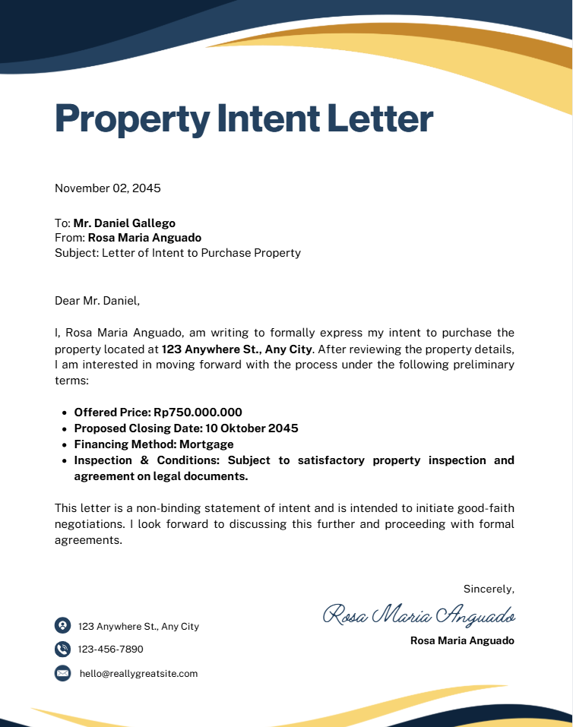
To give you an example, check out this Letter of Intent template made by Crafted templates in Canva.
Business vs. real estate LOI
LOIs exist across industries, but in real estate, they carry more weight and include more detail.
| Business LOI | Real Estate LOI | |
| Tone | High-level, exploratory | Structured, deal-specific |
| Driven by | Mutual intent | Buyer-driven |
| Purpose | Signal intent to collaborate, invest, or partner | Present a formal offer on a specific property |
| Level of detail | Broad strokes, few specifics | Includes price, financing, contingencies, and timelines |
| Analogy | A handshake | A first draft of the deal |
Think of a business LOI as a signal that two parties want to work together—and a real estate LOI as the opening move of an actual transaction.
How LOIs Work in Real Estate Deals
Role in property transactions
A Letter of Intent enters the picture once a buyer gets serious.
They've identified a property, done some initial research, and are ready to move beyond casual interest. Instead of jumping straight into a complex legal contract, they submit an LOI—a concrete proposal that gives the seller something real to react to, without the time and cost of drafting a full agreement.
Where it fits in the negotiation stage
An LOI marks the start of structured negotiations. Rather than going back and forth over scattered emails and calls, both parties use it as a shared reference point—one place where terms can be reviewed, adjusted, and clarified. Typically, the process looks like this:
- Buyer submits an LOI with proposed terms.
- Seller reviews and responds—sometimes with revisions.
- Both sides negotiate key points: price, timelines, and contingencies.
- Once aligned, they move toward a formal purchase agreement.
The LOI itself isn't the final deal. It's the roadmap that gets you there.
So what exactly goes into an LOI? Let’s break down the key elements.
Key Elements of a Real Estate LOI
🏠 Property description
Start with a precise definition of what's being discussed. The more specific you are here, the fewer questions arise later. A solid property description includes:
- Full property address.
- Type of property (residential, commercial, land).
- Size or key specifications.
- Any relevant details (e.g., included assets, parking, zoning).
The goal is simple: make sure both parties are talking about the exact same asset.
💰 Price and financial terms
This is the core of your proposal, and the first thing a seller will look for. At a minimum, include:
- Purchase price (or lease terms).
- Payment structure (cash, financing, installments).
- Earnest money or deposit, if applicable.
- Financing contingencies.
- Who covers closing costs, taxes, and fees.
Clarity here signals that you're a serious buyer—and saves everyone from misunderstandings later.
🧩 Conditions and contingencies
No real estate deal is unconditional—and this is where you define the “what ifs” to protect both sides and set expectations early. Common contingencies include:
- Property inspections.
- Financing approval.
- Title review.
- Zoning or regulatory checks.
Think of it as defining the conditions under which the deal moves forward, or doesn't.
🗓️ Timelines and deadlines
A deal without timing is just an idea. Your LOI should clearly outline:
- Due diligence period (e.g., 30–60 days).
- Target closing date.
- Key milestones along the way.
This helps both sides plan—and keeps the process moving. Clear timelines make your LOI feel structured, realistic, and actionable.
💡 Commercial vs. Residential LOI
Not all LOIs are built the same, and the type of property you're dealing with shapes how detailed your document needs to be.
| Commercial LOI | Residential LOI | |
| Complexity | Detailed and structured | Simpler and straightforward |
| Covers | Financing, due diligence, contingencies, sometimes operational details | Price, basic conditions, timelines |
| Used for | Investment properties, office spaces, multi-unit deals | Straightforward residential transactions |
| Priority | Thoroughness and precision | Speed and clarity |
Presentation Matters More Than You Think
Here's something easy to overlook: sellers often receive multiple offers at once. Those offers get forwarded to partners, investors, and decision-makers—people who weren't part of the initial conversation and may spend only a few minutes with your document.
💡 That means your LOI isn't just being evaluated on numbers. It's being evaluated on how quickly and clearly those numbers can be understood.
Where to find visuals
Buyers don't typically create property visuals themselves. Instead, they work with materials that already exist:
- Professional photos from the listing agent or broker.
- Floor plans and technical drawings from the seller's information package.
- Maps or location materials from listing platforms.
The buyer's main job is to organize and present the text and visuals clearly within their offer.
Make your LOI interactive and easy to share
Traditionally, LOIs are sent as static PDF attachments. But a file sitting in someone's inbox is easy to overlook, and even easier to dismiss as generic.
A more effective approach is turning your LOI into an interactive, shareable document using a tool like FlippingBook. Instead of an attachment, you send a link to a structured digital document that:
- Opens instantly—no downloads required.
- Works smoothly on mobile and desktop.
- Combines text, visuals, and structure in one place.
- Updates instantly—fix typos or make changes on the fly without resending, the document stays under the same link, and everyone always sees the latest version.
- Tracks engagement—so you know who opened it, when, and for how long.
That last point matters more than it might seem. If a seller forwards your LOI to an investor or a business partner, you'll know—and you can follow up at exactly the right moment.
🌟 Wondering what this looks like in practice? Here's a real LOI example built with FlippingBook—clean, easy to navigate, and ready to share.
How to create an interactive LOI with FlippingBook
- Sign up for FlippingBook and upload your LOI as a PDF—your interactive document will be ready in minutes.
- Make it interactive: add pop-up image galleries, property videos, or a contact form so sellers can reach you directly.
- Share via link—send it by email or messenger. No downloads, no attachments.
💡 Don't have a PDF yet? Use a Canva template that we’ve created for our LOI as a starting point or generate one with Canva AI, then upload it straight to FlippingBook via a handy integration.
Create your engaging LOI today
FAQ: Letter of Intent
1. Is a Letter of Intent legally binding?
In most cases, a Letter of Intent (LOI) in real estate is not legally binding. It’s meant to outline the main terms of a potential deal and help both sides align before signing a formal contract. However, certain parts can be binding if explicitly stated—such as confidentiality clauses or exclusivity agreements.
2. Who prepares an LOI?
An LOI is usually prepared by the buyer and sent to the seller as a structured offer. In some cases, especially in commercial real estate, brokers or investment teams help draft or refine the document on the buyer's behalf.
3. How long should an LOI be?
There’s no strict rule, but most LOIs are typically 3–5 pages long. The goal is not to be exhaustive, but to clearly summarize the key deal terms, such as price, timelines, and conditions, without turning it into a full legal contract.
4. What happens after an LOI is signed?
Once both parties agree on the LOI, it becomes the basis for the next stage of the transaction. Typically, this includes:
- drafting a formal purchase agreement.
- conducting due diligence.
- final negotiations of legal terms.
At this point, lawyers and advisors usually take over to turn the agreed terms into a binding contract.
Bringing It All Together
A Letter of Intent is often the quiet starting point of a real estate deal, but it shapes everything that follows.
It helps buyers turn interest into a structured offer, gives sellers a clear way to compare proposals, and sets the tone for smoother, more focused negotiations. Done well, it brings clarity early—long before contracts, legal language, or final commitments come into play.
In competitive markets, the difference between a deal moving forward and stalling often comes down to how well both sides understand each other from the very first document.
Your LOI is that document. Make it count.