The days of the "spray and pray" PR strategy are behind us. For years, agencies and internal teams operated under the assumption that volume was the primary driver of coverage: if you fired off enough press releases to enough generic distribution lists, something was bound to stick. Today, that approach is not just ineffective—it is actively detrimental to your brand’s reputation. Journalists and editors are currently busier than ever: they manage overflowing inboxes and tight deadlines daily. When you treat your outreach as a numbers game, you signal to your audience that your news is not worth their individual attention.
You might have a compelling story, but if you send it as a bulky, static PDF, it will likely trigger spam filters or get buried under a pile of other emails. Journalists need content that is ready to view, share, and utilize immediately.
The goal of this article is to help you shift your perspective: stop thinking of your press release as a one-way notification. The most effective approach starts by transforming your static PDFs into interactive digital flipbooks—a format that opens instantly in any web browser and provides a seamless, immersive reading experience. Once your content is in this digital format, you can share it via trackable links, allowing you to monitor real-time analytics like open rates, time spent reading, and engagement. Throughout this article, we will walk through how to send a press release that uses this modern workflow to turn routine announcements into high-conversion assets.
The Anatomy of a Winning Press Release
The traditional inverted pyramid structure—a gold standard in journalism schools for decades—is still technically sound, but relying on it alone is a mistake. When learning to send a press release, many professionals forget that they are battling for attention against a tidal wave of daily notifications. Let’s see what a winning press release consists of:
🎯 Enticing headline
If your email headline does not command attention within three seconds, it is heading for the trash folder. A magnetic header is not a gimmick—it is a clear, human promise of value. It should speak directly to the reader's needs and immediately address the "why now" factor. According to the Muck Rack State of Journalism Report, the sheer volume of daily pitches forces journalists to use headlines as the primary filter for what gets opened and what gets ignored.
⚖️ Hard facts and narrative storytelling balance
Once you have secured their attention, you must then strike a balance between hard facts and narrative storytelling. Reporters do not want a dry, corporate report full of jargon—they also cannot work with a fluff-heavy marketing pitch that lacks verifiable data.
A winning release provides the essential details: the who, what, when, where, and why, while weaving in a human element that explains the impact of your news. Think of your release as the raw material for an article—your job is to make the story easy for the journalist to visualize, empathize with, and ultimately translate for their own audience.
🔎 Credible sources
By linking to credible, up-to-date sources, such as industry benchmark reports, you establish authority and save the reporter time on fact-checking.
✨ Clear formatting
Finally, do not underestimate the importance of your formatting. You could have the most groundbreaking story in your industry, but if it is buried in a cluttered, poorly structured document, it will fail. Consistent headings, clear bullet points, and appropriate white space make your content skimmable and professional. If a journalist has to fight through walls of text to find your contact details or your key statistics, they will move on to the next email. When your formatting is clean and planned, you demonstrate respect for the reader's time and increase the likelihood that your story receives the coverage it deserves.
💡 Pro tip: Keep your press release under 500 words. Research on PR best practices suggests that shorter, highly readable releases lead to higher engagement rates with busy editors.
The Distribution Landscape: Where to Send Your News
Knowing where to submit a press release effectively is just as important as the story itself. Success in public relations relies on choosing the right distribution for your specific story. A scattergun approach often leads to wasted effort, whereas a tiered strategy ensures your news reaches an audience that actually cares.
Tier 1: Major news outlets to publish press release content
These platforms offer the highest level of visibility. While services like PRWeb or Business Wire can help you reach a massive, broad audience, they are often best reserved for major corporate milestones or high-stakes announcements. Use these wires to establish a baseline of public credibility, but remember that high traffic volume does not always equate to high-quality engagement.
Tier 2: Industry-specific trade publications
For most businesses, this is the "sweet spot" for meaningful coverage.
- Targeted readership: Trade journals serve professionals who are already interested in your sector.
- Technical nuance: When you pitch to these editors, you are talking to people who understand the technical specifics of your industry.
- Qualified leads: These placements often drive more qualified leads than a mention in a generic, high-traffic outlet.
Tier 3: Local and regional media
Never overlook the power of your own backyard. If your announcement has a regional impact, such as a new office opening or a local community partnership, regional reporters are frequently looking for fresh, human-interest stories. These journalists often have a more direct line to your core customer base than national outlets. When you learn how to submit a press release[5] to local outlets, you often find a more direct line to your core customer base.
Beyond traditional press, your distribution strategy must account for social media and influencer outreach. In 2026, many journalists monitor social platforms to identify emerging trends and source quotes. Engaging with relevant industry voices or sharing your news directly on professional networks can often serve as the spark that catches an editor's eye, effectively turning a static announcement into a broader online conversation.
Solving the "Deliverability Gap"
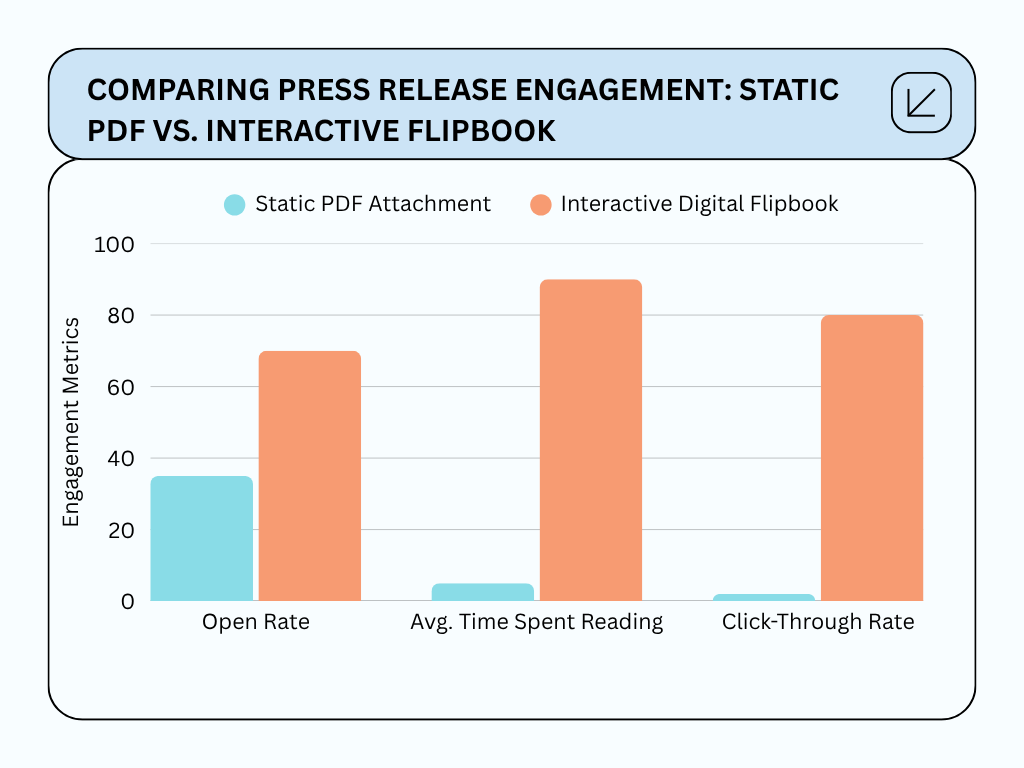
Industry benchmarking data reveals that interactive, web-based flipbooks significantly outpace static files in key engagement metrics—delivering a dramatic uplift in time spent reading and click-through rates. Source: Custom Analysis based on PR Best Practices.
Even with a perfectly crafted pitch, your press release is useless if it never reaches the recipient's eyes. Email filters are increasingly aggressive—they often flag bulky attachments as potential security risks.
📑 The PDF problem
When you send a large PDF, you are essentially asking a busy journalist to download an unknown file—a task that is often blocked by corporate firewalls or avoided entirely due to the fear of malware. Furthermore, if the document is not optimized, the reader may have to deal with slow loading times or broken layouts on mobile devices.
🚀 The flipbook solution
The shift from static attachments to dynamic, digital experiences represents a fundamental change in how to send a press release effectively.
- Transform your PDF: Turn your static documents into interactive digital flipbooks.
- Instant access: A flipbook allows your press release to open instantly in any web browser, without the need for downloads.
- Remove friction: It removes the barriers that cause journalists to hit "delete" before they have even seen your story.
See for yourself! Check out how a digital press release, created by FlippingBook, can look and feel.
Create your interactive press release today
📊 Data-driven PR
Beyond accessibility, trackable links provide the data that traditional PDFs cannot. Because you already know where to submit a press release for maximum impact, you can now use these analytics to see exactly how those specific audiences engage with your content. You can monitor:
- Open rates: See exactly when and how often your press release is accessed.
- Time spent reading: Understand which sections hold a journalist's attention.
- Engagement: Track clicks on internal links, video views, or gallery interactions.
💡 Read our article on how to write a powerful press release.
Creating a Multimedia Press Release
The modern press release is no longer a static document; instead, it is a visual narrative. While your text provides the facts, multimedia elements provide the context and the excitement that editors need to build a compelling story.
🖼️ Embed assets
By embedding high-definition video, interactive charts, and high-resolution image galleries directly into your digital press release, you transform it into an immersive hub of information.
🤝 Respect their time
When you provide a professional, interactive experience, you reduce the workload for the person covering your story. Instead of waiting for a separate link to a video file, they can pull exactly what they need immediately from your document.
📈 Improve coverage rates
Visual storytelling allows for richer, more varied reporting. A video interview can convey passion in a way that a written quote cannot.
💡 Pro tip: Interactive elements aren't just for flair—they drive results. Data from interactive content studies shows that readers spend significantly more time engaging with multimedia-rich documents than static ones.
Measuring Your Press Release Performance
Once you have transitioned to trackable, interactive releases, you get seen. You no longer have to guess if your story resonated—you can see it in the data. Many PR professionals still rely on "vanity metrics," such as the total number of emails sent, but true success is measured by how deep the engagement actually went.
By analyzing the data from your flipbook, you can identify which journalists are genuinely interested in your beat. If a reporter opens your release multiple times and spends several minutes viewing your video assets, they are a high-priority contact for your next announcement. This insight allows you to nurture long-term relationships rather than cycling through endless lists of cold contacts.
- Refine your pitches: Use the feedback from your analytics to adjust your future headlines and content structure.
- Understand the journey: See if your readers are clicking through to your website or social media channels.
- Continuous improvement: Every release becomes a learning opportunity when you have the right metrics to support your next move.
Mastering Direct Outreach and Relationship Building
Even with the best tools in your arsenal, the human element remains the final hurdle. A press release should never be a cold, robotic transaction. When learning how to send out a press release that actually resonates, the art of the personalized pitch lies in demonstrating that you have done your homework—reference a journalist's previous work, mention why your specific story aligns with their current focus, and keep the interaction brief.
- Do your homework: Reference a journalist's previous work and mention why your story aligns with their current focus.
- Follow up with value: Avoid the "spammy" follow-up. Instead, provide genuine value—such as offering an exclusive quote or a new data point.
- Build long-term trust: Your goal is to build relationships—not to force a single placement.
💡 Pro tip: Quality over quantity is the mantra of PR today. Building a relationship with ten journalists who actually trust your content is more valuable than spamming a thousand who will never open your emails.
How You Deliver the News Shapes the Impact
The "where" of your press release distribution is important, but the "how" is what seals the deal. Prioritizing speed, accessibility, and interactivity ensures your message breaks through the noise. The bottom line is simple: if a journalist cannot open or engage with your story instantly, they cannot share it with the world. Stop sending static files and start delivering the professional, digital experiences that modern media demands.
Author's bio